
Not the most successful. Not the most technically brilliant. The one who stayed with you. What made them different?
Almost always it has nothing to do with their competence. It has to do with how they made you feel. They saw you. They were real with you. They shared their thinking, their uncertainty, their genuine care. They were a real human being in a role that often asks people to be anything but.
And here is something I have noticed in my coaching work. When I ask leaders to think about that person, something shifts in the room. People soften. They remember something important.
And sometimes a leader says something that stays with me.
"I have never had that. I have never worked with someone like that."
Not because the leaders around them did not care. But because somewhere along the way, those leaders learned to keep themselves hidden. To perform rather than to be.
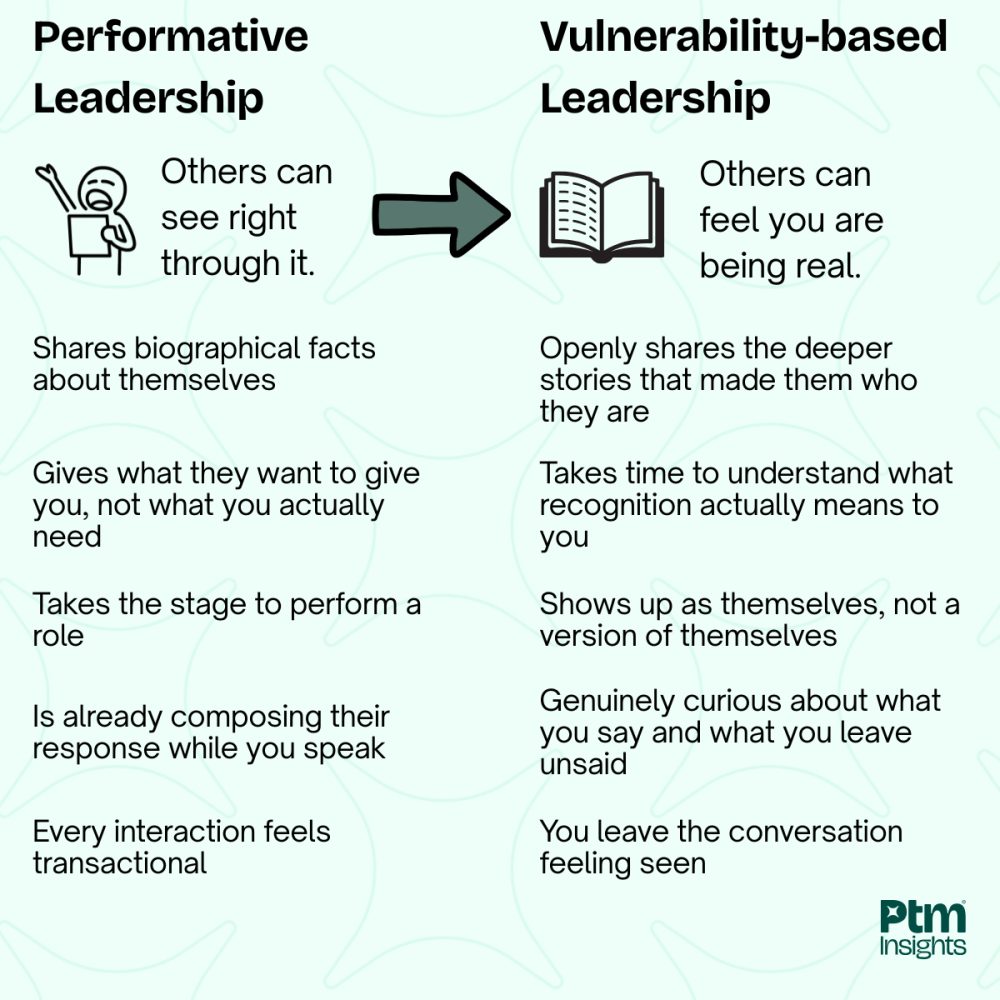
That quality - the thing that made your best leader unforgettable - has a name: Vulnerability. It's not weakness. It's not oversharing. It is the willingness to be seen as a real person and to see others the same way.
Brené Brown's research on daring leadership shows consistently that vulnerability is not a personality trait. It is a choice. Patrick Lencioni, whose Five Behaviors of a Cohesive Team work many leaders will recognize, calls it the foundation of vulnerability-based trust: the deepest and most durable form of trust a team can build. And in the Leadership Circle Profile, one of the highest indicators of leadership effectiveness is what researchers call Courageous Authenticity: the willingness to be genuinely known, even when that feels risky.
I will go first. I grew up in New York as a second-generation immigrant, an only child, moving between a traditional Chinese family at home and the American education system outside of it. For a long time, I learned to hide parts of myself depending on which world I was in. That experience shaped how I defined success, how I performed for others, and ultimately how hard I had to work to find my own authentic voice. It is part of why this work matters so much to me.
Lencioni calls this low-risk vulnerability. And it is one of the simplest ways to begin. In your next team meeting or your next one-on-one, ask three questions. Answer them yourself first.
That is it. No framework required. No vulnerability training needed. Just three questions that turn colleagues into people, and a leader who goes first.
Notice what happens in the room. Notice what you feel when you share your own answers. That noticing is the beginning of something worth paying attention to.
This is the first article in a new series on vulnerability: what it actually looks like in leadership, why it is worth developing deliberately, and what gets in the way. I am always curious to know from others:
Who was that leader for you? And what did they do that stayed with you?
If this has sparked some curiosity, I would love to continue the conversation at diane@ptminsights.com. It is some of the most meaningful work I do.